Western Australia’s On Demand Transport industry is entering a new era. As customer expectations, safety responsibilities and operational complexity continue to increase, operators need more than vehicles and drivers, they need connected digital systems that support professionalism, accountability and growth. Four CEES Group is developing RIDYNE, an ODBS technology platform designed to help operators transition from traditional manual processes towards a digitally managed passenger transport ecosystem aligned with the future direction of WA’s transport industry.
The passenger transport industry is undergoing one of the biggest transitions in decades.
For many years, professional transport was built around a simple model:
A customer needs a journey.
An operator provides a vehicle.
A driver completes the trip.
That model worked for generations.
However, the expectations of customers, businesses, regulators and the wider community have changed.
Today, professional passenger transport is no longer simply about providing a vehicle and a driver.
It is about delivering a safe, reliable, transparent and professionally managed mobility experience.
This evolution is why Four CEES Group is developing RIDYNE, a technology platform designed specifically for the On Demand Transport industry.
RIDYNE was not created simply as another booking system.
It was created because the industry needs a stronger digital foundation that helps operators manage the complexity of modern passenger transport while supporting the direction of where the industry is heading.
Understanding the Changing On Demand Transport Landscape
In Western Australia, the On Demand Transport sector operates under the oversight of the Department of Transport and Major Infrastructure (DTMI).
Through initiatives such as the On Demand Transport Industry Reference Group (OdTIRG), government and industry stakeholders have been working together to better understand the challenges, opportunities and future needs of the sector.
The discussions throughout 2025 highlighted several important themes:
1. Improving safety assurance
The industry is moving towards stronger safety management practices.
This includes:
- better operational processes
- stronger record keeping
- improved accountability
- more consistent standards across operators
Safety is not simply about meeting minimum requirements.
A mature transport business should be able to demonstrate:
- how drivers are managed
- how vehicles are maintained
- how incidents are recorded
- how customers are protected
- how risks are identified and controlled
2. Increasing professionalism across the industry
The On Demand Transport sector has grown rapidly.
Today it includes:
- chauffeur operators
- limousine businesses
- rideshare operators
- tourism transport providers
- corporate transport specialists
While these businesses may operate differently, they share the same responsibility:
Moving people safely and professionally.
The future industry is likely to place greater emphasis on operators having structured systems rather than relying on informal processes.
The question is changing from:
“Do you have an authorised vehicle and driver?”
to:
“Can you demonstrate that your transport service operates professionally?”
3. Digital transformation and better industry connectivity
One of the clearest trends across industries is the move towards digital systems.
Transport is no different.
Modern operators require:
- automated booking management
- real-time communication
- driver coordination
- digital records
- reporting capability
- customer visibility
Technology is no longer simply a convenience.
It is becoming the foundation that allows businesses to operate efficiently, safely and competitively.
Why Four CEES Created RIDYNE
Four CEES Group was founded around a simple belief:
The future of professional transport requires connection.
Connection between:
- operators
- drivers
- passengers
- businesses
- technology
Historically, many smaller transport operators have relied on disconnected tools:
- spreadsheets
- phone calls
- text messages
- manual invoicing
- separate systems that do not communicate
These methods can work when a business is small.
However, as expectations increase, they create challenges:
- more administration
- increased risk of mistakes
- reduced visibility
- difficulty scaling
- limited business intelligence
RIDYNE was developed to provide a digital operating layer that helps solve these challenges.
RIDYNE’s Role in the Future Transport Ecosystem
RIDYNE sits between regulation and operation.
It does not replace government requirements.
It helps operators meet them more effectively.
The future ecosystem looks like this:
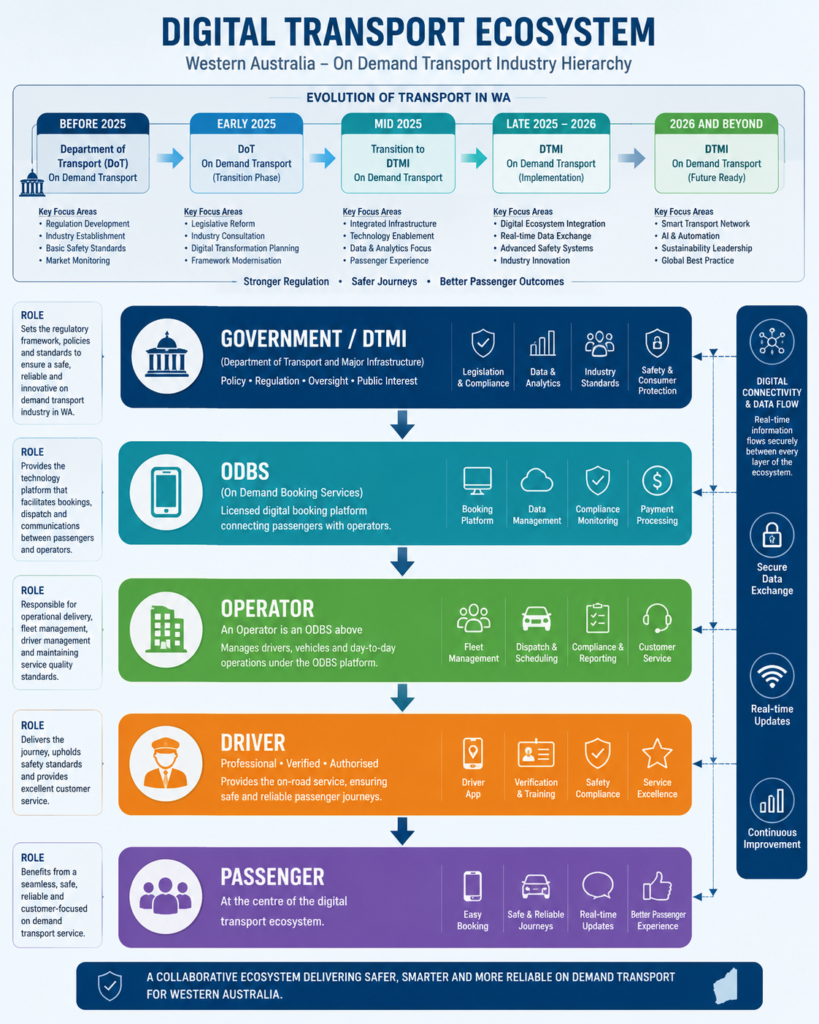
RIDYNE provides the connection point where daily operations become structured, visible and manageable.
Aligning Technology With Safety
One of the biggest opportunities for technology is improving safety outcomes.
A digital operating platform can help operators create better visibility around:
Driver management
Including:
- driver information
- availability
- allocations
- operational history
Vehicle management
Including:
- vehicle records
- suitability
- availability
Trip management
Including:
- booking details
- driver assignment
- passenger journey records
- completion information
Reporting
Allowing operators to understand:
- performance
- reliability
- incidents
- customer feedback
Safety improves when businesses have information available to make better decisions.
Supporting Small and Medium Operators
Large transport companies often have access to sophisticated systems.
Small and medium operators often do not.
Yet they are responsible for delivering the same standard of service.
This is where RIDYNE’s purpose is important.
The goal is not to make every operator operate like a large corporation.
The goal is to provide professional tools that allow smaller operators to compete, grow and operate with confidence.
A small chauffeur business should be able to access the same quality of operational infrastructure as a much larger organisation.
Building an Industry Ecosystem, Not Just Software
Four CEES sees the future of On Demand Transport as an ecosystem.
An ecosystem where:
Operators have better tools.
Drivers have clearer communication.
Customers receive greater confidence.
Businesses receive professional transport solutions.
Regulators see a more mature and accountable industry.
This is why RIDYNE is being developed with the wider industry in mind.
The objective is not simply to sell software.
The objective is to contribute to the professionalisation of the industry.
The Future of Professional Transport
The industry is moving from:
“A driver with a car”
towards:
“A digitally managed passenger transport service.”
That does not remove the importance of the driver.
Quite the opposite.
Technology should support the professional driver by reducing administration, improving communication and allowing them to focus on what matters most:
Delivering an exceptional passenger experience.
Looking Ahead
The conversations happening through DTMI and OdTIRG demonstrate that the industry is entering a new phase.
A phase focused on:
- safety
- accountability
- professionalism
- technology
- customer confidence
Four CEES Group believes that the operators who embrace this evolution will be best positioned for the future.
RIDYNE is our contribution to that future.
Not just a booking platform.
A foundation for a more connected, professional and sustainable On Demand Transport ecosystem in Western Australia.